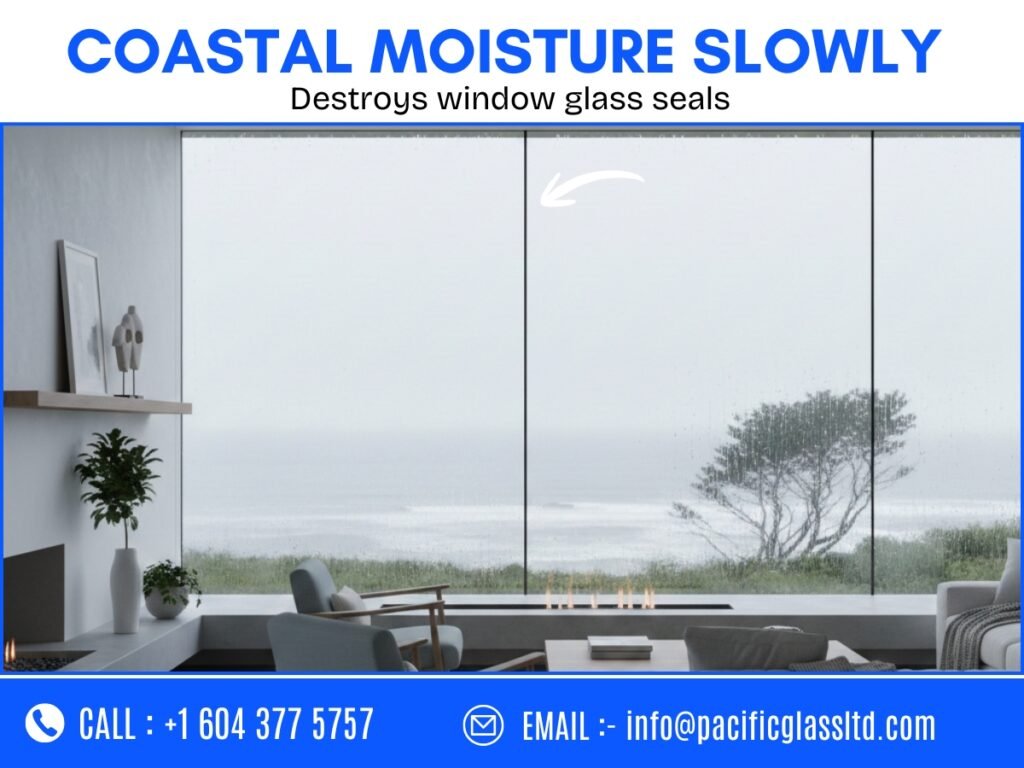
Coastal living has undeniable appeal. Fresh air, scenic views, and a mild climate make places like Burnaby and the surrounding Lower Mainland highly desirable. But behind that comfort lies a persistent, invisible threat to modern homes—coastal moisture.
At Pacific Glass Ltd, we regularly see homeowners puzzled by foggy windows, drafts, or unexplained heat loss. The cause is rarely dramatic or sudden. Instead, it’s a slow breakdown of glass seals, quietly weakened by moisture in the air year after year.
Glass seal failure doesn’t happen overnight. It’s the result of constant exposure to humidity, rain, temperature changes, and airborne salts—conditions that coastal environments create naturally. Over time, even high-quality windows can lose their integrity.
This article explains how coastal moisture damages glass seals over time, why the damage is gradual but inevitable, and how homeowners can recognize the signs before small issues turn into expensive problems.
What Exactly Is a Glass Seal?
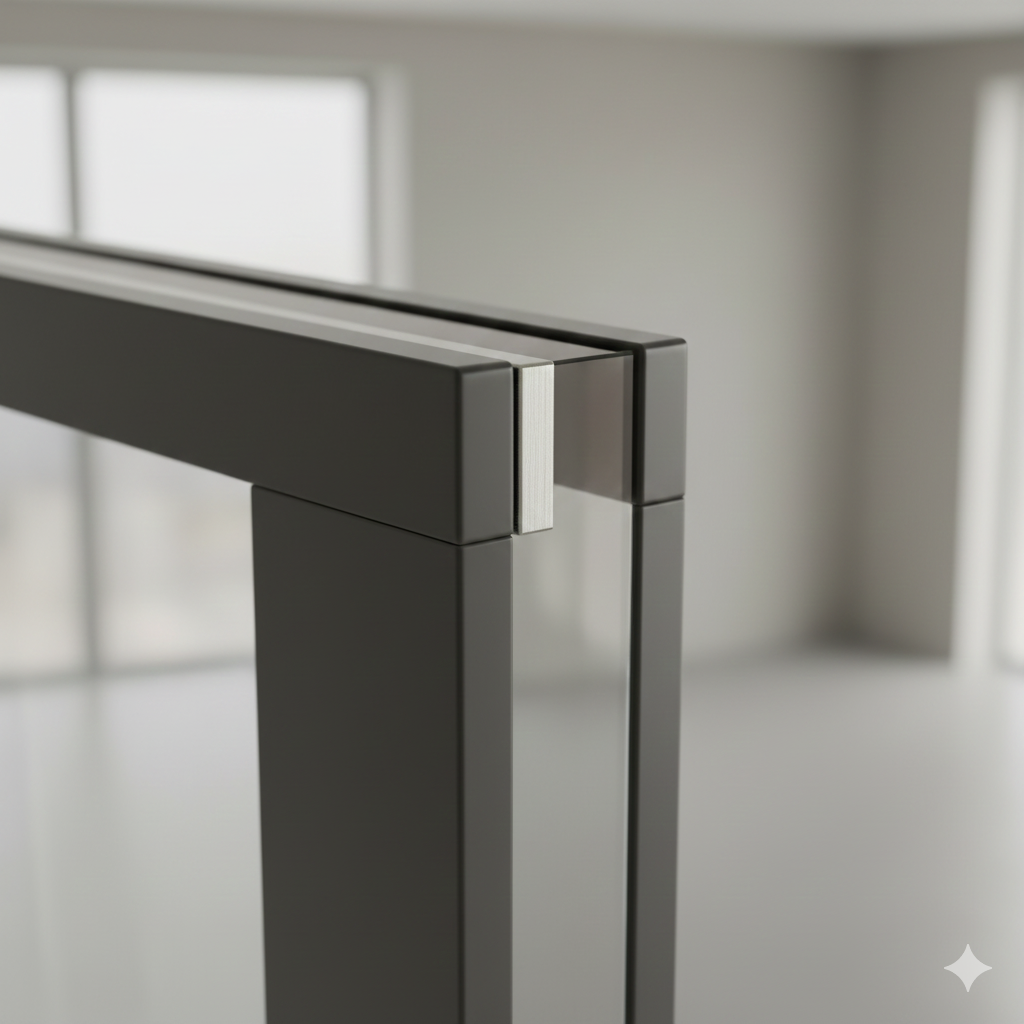
Modern windows are designed as sealed systems. In double- or triple-pane glass, two or more panes are bonded together along the edges with a specialized seal. Between them is insulating gas—usually argon or krypton—which improves thermal efficiency and reduces condensation.
A healthy glass seal:
- Keeps insulating gas inside
- Blocks moisture and air infiltration
- Maintains clarity and insulation
Once that seal is compromised, the window begins to fail—even if the glass itself remains intact.
Why Coastal Moisture Is So Damaging
Moisture in coastal regions isn’t limited to rain. It exists as:
- Persistent humidity
- Airborne water particles
- Wind-driven moisture
- Condensation caused by temperature changes
In places like Burnaby, moisture exposure is constant, not seasonal. Windows never fully dry out for long periods, especially on shaded or wind-facing sides of buildings.
At Pacific Glass Ltd, we often describe coastal moisture as a slow corrosive force—not destructive in a single moment, but relentless over time.
The Gradual Breakdown of Glass Seals
Glass seal damage happens in stages:
Stage 1: Micro-Expansion and Contraction
Every day, glass and frame materials expand and contract as temperatures change. Coastal moisture amplifies this movement by:
- Softening seal materials
- Penetrating microscopic gaps
- Weakening adhesives
This movement is subtle but constant.
Stage 2: Moisture Penetration
Once tiny gaps form, moisture enters the seal area. Even minimal intrusion can:
- Displace insulating gas
- Introduce humidity between panes
- Begin internal condensation
At this stage, damage is invisible.
Stage 3: Chemical Degradation
Moisture reacts with sealants and spacer materials. Over time:
- Seal compounds lose elasticity
- Adhesive bonds weaken
- Structural integrity declines
Pacific Glass Ltd often finds that seals fail chemically long before they fail visually.
Stage 4: Seal Collapse
Eventually, the seal can no longer hold. Moist air fully enters the glass unit, insulating gas escapes, and fogging becomes visible.
By the time homeowners notice the issue, the seal has already failed completely.
Why Coastal Areas Accelerate Seal Failure
Coastal environments combine several stress factors:
- High humidity: Constant moisture pressure on seals
- Wind exposure: Forces moisture deeper into joints
- Salt particles: Accelerate material degradation
- Mild winters: Frequent freeze-thaw cycles rather than stable cold
These conditions are especially hard on windows installed 15–25 years ago, before today’s improved seal technologies.
Why Condos Are Especially Vulnerable
At Pacific Glass Ltd, we see faster seal failure in condos than in detached homes.
Why?
- Higher elevation increases wind pressure
- Large glass panels flex more
- Limited ventilation traps interior moisture
- Shared building envelopes move over time
Balconies, corner units, and west-facing windows are particularly prone to moisture-driven seal damage.
The Illusion of “Still Working” Windows
One of the most dangerous misconceptions homeowners have is that windows are fine as long as they:
- Aren’t cracked
- Don’t leak visibly
- Still open and close
In reality, a window can look perfect while performing poorly. Seal failure begins internally, often years before fogging appears.
Pacific Glass Ltd frequently replaces glass units that homeowners assumed were “still good” because the problem wasn’t obvious yet.
How Moisture Triggers Fogging Between Panes
Once moisture enters the sealed space:
- Temperature differences cause condensation
- Moisture becomes trapped
- Fog forms and remains
Unlike surface condensation, this fog:
- Cannot be wiped away
- Appears year-round
- Gradually worsens
This is the most recognizable sign of seal failure—and a clear indication replacement is necessary.
The Energy Efficiency Impact
A failed seal doesn’t just affect visibility—it dramatically reduces insulation.
Consequences include:
- Heat escaping in winter
- Increased cooling loss in summer
- Drafty indoor conditions
- Higher energy bills
In coastal climates where heating systems run for long periods, this loss compounds quickly.
Moisture Spread Beyond the Glass
Once a seal fails, moisture rarely stays contained. It migrates outward, affecting:
- Window frames
- Surrounding drywall
- Interior finishes
Over time, this can cause:
- Paint bubbling
- Wood swelling
- Mold-friendly conditions
Pacific Glass Ltd often encounters homes where window seal failure led to secondary repairs that could have been avoided with earlier glass replacement.
Why DIY Fixes Don’t Stop Seal Damage
Homeowners sometimes try:
- Defogging sprays
- Drilling glass
- Sealant patches
These methods don’t restore insulating gas or structural integrity. In some cases, they accelerate moisture intrusion or damage frames further.
Once moisture compromises a seal, replacement is the only lasting solution.
Modern Glass vs Older Seal Technology
Seal technology has improved significantly in recent years. Modern glass units use:
- Advanced spacer systems
- Improved seal compounds
- Better gas retention
- Enhanced moisture resistance
When Pacific Glass Ltd replaces failed glass, many homeowners notice immediate improvements in comfort, clarity, and noise reduction—even without changing the window frame.
Why Early Replacement Matters
Replacing glass early:
- Prevents moisture from spreading
- Protects frames and walls
- Maintains energy efficiency
- Reduces long-term costs
Waiting until seals completely collapse often means additional repairs beyond the glass itself.
How Pacific Glass Ltd Approaches Coastal Seal Damage
At Pacific Glass Ltd, we focus on precision solutions, not unnecessary replacements. Our approach includes:
- Identifying seal failure stages
- Assessing moisture exposure
- Evaluating frame condition
- Replacing only the glass when possible
This targeted method is ideal for coastal homes where full window replacement may not be necessary or practical.
Long-Term Protection in Coastal Homes
While moisture can’t be eliminated, homeowners can slow seal damage by:
- Managing indoor humidity
- Ensuring proper ventilation
- Addressing condensation early
- Scheduling professional assessments
These steps won’t stop aging—but they can extend window performance significantly.
Final Thoughts
Coastal moisture is patient. It doesn’t rush. It works slowly, quietly, and consistently against glass seals—until one day, fog appears and performance drops.
Understanding how moisture damages glass seals over time empowers homeowners to act before problems escalate. Clear windows, efficient insulation, and dry interiors depend on healthy seals.
At Pacific Glass Ltd, we help coastal homeowners protect their homes from the long-term effects of moisture—by recognizing seal failure early and applying the right solution at the right time.Because in coastal climates, clarity isn’t permanent—but it is restorable.
FAQs
Coastal moisture penetrates window seals through constant humidity, temperature changes, and wind pressure, gradually breaking down seal materials and allowing moisture inside.
High humidity and airborne moisture cause window seals to fail faster, leading to condensation trapped between glass panes.
No. Once a glass seal fails, it cannot be repaired. The sealed glass unit must be replaced to restore insulation and clarity.
In coastal environments, glass seals typically last 15–25 years, depending on exposure, installation quality, and maintenance.
Replacing failed glass restores insulation and clarity, but managing indoor humidity and ventilation helps extend the lifespan of new seals.

JAP Jabar is the highly skilled and experienced owner of Pacific Glass Ltd, a trusted leader in glass services throughout British Columbia, Canada. With over 15 years of experience in glass repair, installation, and design, JAP has built a strong reputation for excellence in providing top-tier glass solutions, including glass doors, windows, railings, balconies, and more. Whether it’s residential or commercial, JAP is committed to delivering quality and precision in every project. Pacific Glass Ltd offers a wide range of services, from sliding doors and swing doors to storefront glass, patio glass doors, mirror services, and shower glass installations, ensuring customers receive the best in durability, aesthetics, and functionality.
Pacific Glass Ltd serves clients across Burnaby, Vancouver, and greater British Columbia with a focus on offering high-end glass solutions that meet the unique needs of each space. JAP’s expertise spans multiple types of glass services, including glass & sealed unit replacement, windows repair, commercial doors, fixed walls, glass canopies, and more. As a locally owned and operated business, JAP’s commitment to excellence shines through in every project, earning him a reputation as one of the leading glass specialists in the area.