
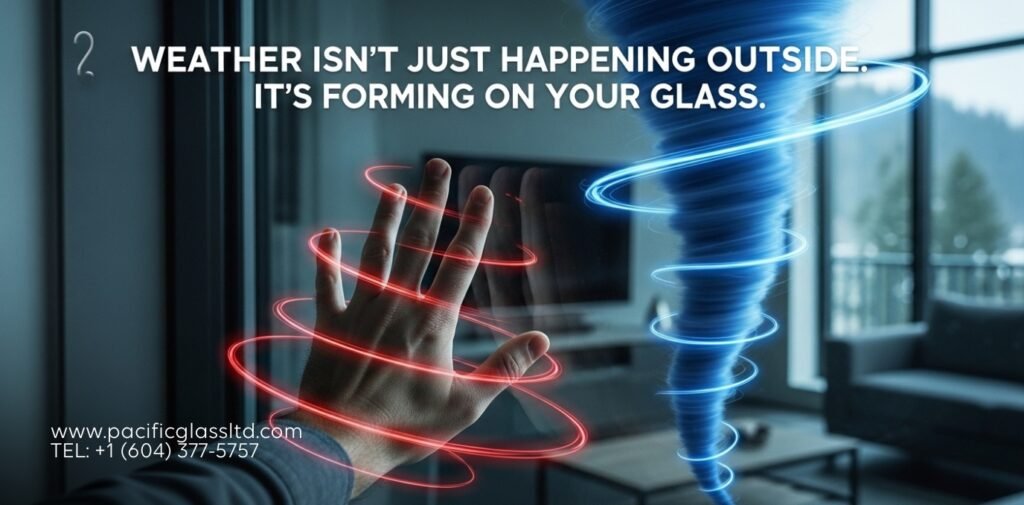
Most homeowners think weather only happens outside—in the wind, the rain, the sun, and the shifting seasons. But the truth is surprising, and a bit unsettling:
Weather also forms inside your home.
Windless drafts, temperature pockets, humidity swings, cold zones, warm corners—your windows quietly create them every single day.
You don’t see it.
You don’t hear it.
But you feel it, every time a room is unexpectedly cold, stuffy, damp, or uneven.
This is the secret world of invisible indoor weather—a micro-climate created not by your thermostat, not by your environment, but by something you stare through every day:
Your windows.
In this deep dive, Pacific Glass Ltd uncovers how your windows quietly shape the comfort of your Burnaby, Vancouver, Richmond, Coquitlam, and Surrey homes—often without your permission.
PART 1 — What Is an Indoor Micro-Climate?
Every home has a “main climate” controlled by your heating, cooling, and ventilation systems. But within that climate are miniature weather systems created by surfaces, materials, and—most importantly—your glass.
An indoor micro-climate forms when:
- a window loses its insulating strength
- outdoor temperature leaks inward
- humidity collects in cool pockets
- glass cools or heats faster than walls
- airflow moves unpredictably around the frame
Think of it like this:
Your window becomes the “sky,” the interior becomes the “ground,” and the space between them becomes a tiny weather zone.
Some common symptoms:
✔ A chilly pocket near the glass
✔ Condensation forming only in one corner
✔ A warm spot on one side of the room
✔ A draft even when everything is closed
✔ A window that fogs at night but not during day
✔ One room always feeling “off”
These aren’t random.
They are weather events.
And your window started them.
PART 2 — How Windows Accidentally Become Weather Machines
1. Temperature Loss = Cold Fronts Indoors
Every window is a temperature translator.
Whatever happens outside… tries to happen inside.
If the seal weakens or the insulation (argon gas) escapes, your window becomes the perfect spot for a cold front, just like in nature.
And cold fronts always create wind.
Even inside a sealed room.
That’s why homeowners often swear they feel a “draft” even when the window isn’t technically leaking air.
It’s not a leak—
It’s physics.
Warm indoor air rises.
Cold air sinks along the glass.
That downward movement creates a micro wind you can feel.
2. Condensation = Indoor Rain Events
When warm, humid air touches cold glass, moisture collects.
To a scientist, this is predictable.
To a homeowner, this looks like:
- sweating windows
- water pooling on sills
- mildew forming
- mysterious damp areas
These are not accidents.
These are precipitation events happening inside your home.
Your home becomes its own weather system.
3. Pressure Shifts = Airflow Waves
Insulated glass units (IGUs) change air pressure depending on:
- sunlight
- nighttime cooling
- seasonal shifts
- trapped gas movement
When pressure inside the glass shifts, the air around the window shifts too.
The result?
Invisible airflow waves, which homeowners often sense as:
- hot spots
- cooling swirls
- odd temperature gradients
Your window is creating an indoor climate map—
just like an outdoor weather satellite.
4. Light Distortion = Visual “Haze” Weather
Old or weakening seals cause refracted light patterns.
This leads to:
- duller daylight
- dim visual corners
- uneven brightness
- hazy perspectives
It’s not your eyes.
It’s your window atmosphere bending light.
PART 3 — The Role of Double-Pane Glass in Indoor Climate
Double-pane windows are supposed to create a stable thermal barrier.
When new, they do it beautifully.
But over time…
- seals loosen
- argon gas leaks
- moisture sneaks inside
- temperature transfer increases
Suddenly, your windows no longer manage climate—
they create it.
Pacific Glass Ltd sees this every week across Burnaby and surrounding cities.
Homeowners complain:
“My room is always cold.”
“My windows fog only at night.”
“My living room feels stuffy.”
“My bedroom warms unevenly.”
These aren’t HVAC problems.
These are window micro-climate indicators.
PART 4 — How Micro-Climates Impact Your Life
You may not see the invisible weather, but you definitely feel its consequences.
1. Rising Energy Bills
Your HVAC works overtime to correct the weather your windows create.
2. Uneven Comfort
One room feels like summer, the next like fall.
3. Allergens Multiply
Moisture pockets encourage mold, dust mites, and microbes.
4. Furniture Fades
Hotspots from distorted UV create aging zones.
5. Sleep Disruption
Micro drafts near the bed change your sleep temperature.
6. Higher Repair Costs Later
Indoor weather signals window decline long before homeowners notice.
Your home becomes unpredictable—
and comfort becomes a guessing game.
PART 5 — Where These Micro-Climates Usually Form
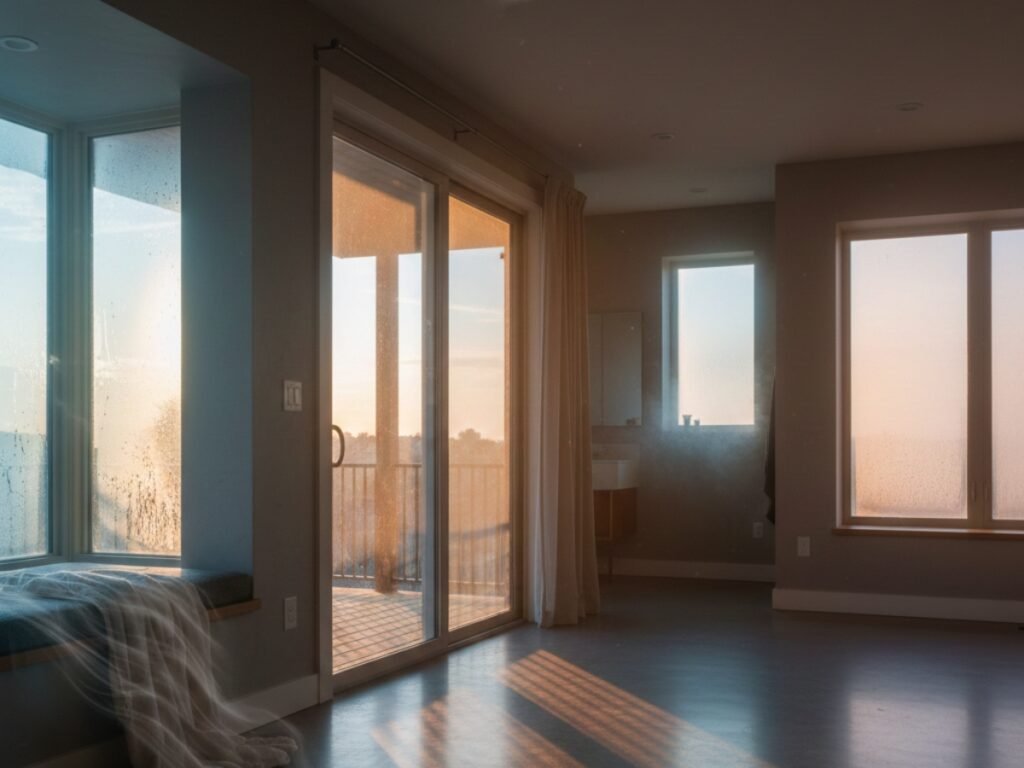
Through thousands of service calls, Pacific Glass Ltd identified the most common trouble zones:
Windows Facing West
Heat loads create temperature waves.
Older Sliding Windows
Weak seals + minimal insulation.
Balcony Door Glass
Huge surface area = huge climate impact.
Bathroom Windows
Natural humidity + cold morning glass = constant condensation.
Bedrooms Facing North
Cool air sinks, creating micro drafts.
Bay Windows
Multiple angles = multiple weather zones.
Each surface has its own “weather personality.”
Your home is a landscape.
Your windows are the climate centers.
PART 6 — How Pacific Glass Ltd Fixes Invisible Indoor Weather
Here’s where the science meets the solution.
1. Seal Testing
We check for micro-gaps invisible to the human eye.
2. Gas Loss Detection
Low argon levels = temperature instability.
3. Moisture Mapping
We identify where condensation is forming—and why.
4. Temperature Gradient Scans
Shows where microclimates exist inside your room.
5. Replacement or Resealing Options
Each window gets a custom plan.
No guesswork.
No unnecessary replacement.
Our goal:
Turn your indoor weather back into indoor comfort.
PART 7 — The Takeaway: Invisible Weather Is a Warning
If your home feels:
- colder than it should
- damp only in certain corners
- uneven in temperature
- foggy only at night
- drafty near windows
…your windows are speaking to you.
They are telling you:
“I’m creating a climate you didn’t authorize.”
The good news?
Pacific Glass Ltd can stop that weather system before it becomes a storm.
FAQs
Yes. Weak seals, lost insulation gas, and thermal transfer can create noticeable hot or cold spots—just like outdoor micro-climates.
That window likely has a unique thermal weakness, creating a humidity pocket. It’s an early warning sign of seal fatigue.
Absolutely. Older seals fail slowly, creating uneven temperature zones and humidity pockets.
Often, yes. Seal repair, IGU replacement, or targeted restoration can solve most issues.
Because invisible window weather is the earliest sign of window decline—and fixing it restores comfort before costs escalate.

JAP Jabar is the highly skilled and experienced owner of Pacific Glass Ltd, a trusted leader in glass services throughout British Columbia, Canada. With over 15 years of experience in glass repair, installation, and design, JAP has built a strong reputation for excellence in providing top-tier glass solutions, including glass doors, windows, railings, balconies, and more. Whether it’s residential or commercial, JAP is committed to delivering quality and precision in every project. Pacific Glass Ltd offers a wide range of services, from sliding doors and swing doors to storefront glass, patio glass doors, mirror services, and shower glass installations, ensuring customers receive the best in durability, aesthetics, and functionality.
Pacific Glass Ltd serves clients across Burnaby, Vancouver, and greater British Columbia with a focus on offering high-end glass solutions that meet the unique needs of each space. JAP’s expertise spans multiple types of glass services, including glass & sealed unit replacement, windows repair, commercial doors, fixed walls, glass canopies, and more. As a locally owned and operated business, JAP’s commitment to excellence shines through in every project, earning him a reputation as one of the leading glass specialists in the area.